Passionate Moderate Manifesto

The idea of civilization either “progressing” or “conserving” itself is useless. Sometimes doing what’s “good” for the world and its inhabitants needs something radical. Other times, it requires holding onto something traditional.

Long ago, G.K. Chesterton said:

The whole modern world has divided itself into Conservatives and Progressives. The business of Progressives is to go on making mistakes. The business of Conservatives is to prevent mistakes from being corrected. Even when the revolutionist might himself repent of his revolution, the traditionalist is already defending it as part of his tradition. Thus we have two great types — the advanced person who rushes us into ruin, and the retrospective person who admires the ruins. He admires them especially by moonlight, not to say moonshine. Each new blunder of the progressive or prig becomes instantly a legend of immemorial antiquity for the snob.

So don’t commit to being a “Progressive” or a “Conservative.”

Don’t commit to Revolution. Or Counterrevolution. Or Reform. Or Orthodoxy. Take a genuine shot at solving problems and making the world a better, freer place. Commit to THAT. Commit to approaching the world with clear eyes, empirical evidence, rigorous reasoning, intellectual honesty and compassion. Commit to these.

Paranoia In Shifts

Some people will believe the very worst about others.  Well, not all others, just some others….

People will believe that president Obama would euthanize their grandparents. They will believe that he “hates white people.” They will cry in public and ask for their “America back” — when to most of us America doesn’t look all that different from last year. That is, unless there really is no place in one’s America for a black president — but I don’t honestly believe that’s what that woman was thinking. Even if race played into her fears, I’m pretty sure it was subconscious.

So why is it that people are willing to believe such extreme things about Obama and the Democrats? Why are they willing to believe, not just that they have misguided ideas, but that they have such actively evil intentions? It seems incredible to me.

A friend of mine asked me an interesting question the other day. “Do you think this is how conservatives felt during the Bush years?” She wondered. “That they couldn’t figure out why so many were fearful of the administration’s policies — not just disapproving, but fearful?”

My friend, much like me, is a “liberal” in her values, without being committed to any technocratic or partisan political agenda. We are liberals because we believe in freedom and compassion and fairness. We want things like poverty and discrimination to be eradicated without necessarily being wedded to particular policy approaches. We love the founding fathers and will fight any white supremacist who tries to appropriate them for their own sick visions of “their” America. We are willing to be just as hard on the government under President Obama as we were on the one under President Bush on all the same issues: state secrets doctrine, extraordinary renditions, military tribunals, don’t-ask-don’t-tell, wall street bailouts with practically no strings attached. . . etc.

And yet, we too, are willing to accept that the Obama people aren’t dangerous in ways that maybe we weren’t always absolutely certain about the Bush people. (Although sometimes I do think Tim Geithner is the devil, but that’s a different post).

I will say this, though: the whackos on the left — the ones that used to peddle anti-Bush theories that 9/11 was an “inside job” or that the delay in responding to Katrina was a result of Bush “hating black people” — never really got traction with mainstream or influential liberals. Not one factually unproven conspiracy-type theory about the Bush administration was taken up by anyone prominent enough that I can recall his/her name. Dan Rather doesn’t count — he relied on the wrong documents but his charge, that Bush didn’t fulfill his National Guard duties, was true and substantiated; and even if he does count, that’s just ONE. On the other hand, mainstream, influential conservatives — Bill Kristol, Lou Dobbs, Sarah Palin, Bill O’Reilly, Sean Hannity — don’t seem to have any qualms about giving credence to complete fabrications about “death panels” and “Kenyan citizenship.”

I will also say this: for all the conservative accusations of inadequate liberal respect for our erstwhile “commander-in-chief” — no liberal ever actively wanted President Bush to fail as a president. We just wanted him to be a better president. Rush Limbaugh actually said he wanted Obama to fail (and Fred Thompson and Bobby Jindal defended him in this). Can you imagine the Fox News response if someone had said that about Bush? Despite the conservative alarm at liberals not caring about the security of our country, it was a conservative that wanted Osama bin Laden to attack our country.

I will say this, too: I wouldn’t have any reason to be paranoid about President Bush if he didn’t actually lie to us about the reason we went to war with Iraq; if he didn’t try to usurp legislative power with elaborate “signing statements”; if he didn’t have guys like Cheney, Rumsfeld, Ashcroft, Gonzalez, Bybee, and Yoo working for him (I know, I know, Tim Geithner. . . but he’s kind of a lesser devil, like Phil, The Prince of Insufficient Light).

Nevertheless, I think my friend has a point. What we tend to see as “flawed” rather than “evil” may often be a product of our own invention, at least in part, and this might apply to even the least partisan, most fair-minded and judicious among us. That’s bad enough, but what’s really scary is that so very many of us these days are deliberately, and gleefully partisan with absolutely no intention of being fair-minded or judicious.Maybe it’s “their” turn to be paranoid. So much for the post-political neo-camelot.

The Absolute Value of Truth

Some people have so little credibility that even if they happen to say something correct, we are entitled to tell them to shut up. But that doesn’t mean we adopt the opposite posture just because we want to oppose them.Dick Cheney is such a person.  Hillary Clinton is correct that Dick Cheney has no business asking for “transparency” from government in relation to its release of the torture memos. Not only was his administration shrouded in secrecy and given to disclaiming any obligation of public accounting of any kind; but he has also been severe in opposing this particular set of de-classifications.

What’s “transparent” is Mr. Cheney’s deeply principled commitment to the public’s right to know. . . whatever might be exculpatory for him and his peeps. Nobody owes him that.

BUT. . . if there are documents that contextualize the shameful new facts we are learning about the use of torture as an interrogation tool, we really should have that information, irrespective of Cheney’s request.

Notice I said “contextualize” not “mitigate.” Acts that are immoral, unconstitutional, and in violation of our international agreements are still all those things even if they are spectacularly successful in meeting the objectives for which they were designed. Our constitution is replete with prohibitions against wonderfully “effective” things that government could do.

* Suppression of speech and assembly is an excellent prophylactic against insurrection.

* Broad searches and seizures powers are great for prosecuting criminals.

* A government without checks and balances has far less gridlock.

All these barriers on government likely militates against the smoothest possible functioning of government’s otherwise permitted activities.

But our founders chose to provide such inefficiency-inducing mechanisms to avoid abuse of discretion. They put a higher premium on the quality of our lives – as freely determined by us – than on the logistical efficacy of how our government functions.

Plenty of people already think that torture yields useful information. Would it surprise anyone that some memos indicating that view were written by Bush administration advisers? These are the guys who got their people to (1) find strong evidence of WMDs and an Iraq-Al Qaeda connection just in time to drag us into a war they were looking for an excuse to launch, (2) torture — excuse the pun — all reason, tradition, and canons of text-construction to somehow conclude that American laws(!) permitted them to treat detainees in ways worthy of Saddam Hussein, and (3) sign off on the legal theory that the president can unilaterally declare someone an “enemy combatant” and detain him indefinitely without review or appeal.

OF COURSE they had memos extolling the virtues of torture! Let us see the documents. All the documents – you can redact any particular info that compromises national security.

*We are going to take anything the Bush people had to say about torture with a large grain of salt. Trust us.

*We are not going to assume that the morality or legality of torture turns on its effectiveness at gaining intelligence, if that is indeed shown to be true. Trust us.

* Most importantly, even if we do decide that those memos completely exonerate the Bush Administration, that’s kind of our prerogative.  Your job is not to direct our opinions. Your job is to tell us the whole truth. Your job is to TRUST US.

The Properties of Property and the Reality of Reality

I was talking yesterday to a friend about my concerns regarding assertions of absolute private “property rights” over stuff taken out of the public domain. My friend, an architect by training, is vehemently opposed to anything that remotely resembles a restraint on commerce and wealth accumulation. She describes herself as “nearly objectivist.” She says she was “a typical liberal intellectual” when she first started studying architecture some twenty years ago. Then, in the Autumn of 1991, she read a little book about a brilliant fictional architect, that turned her around. (That book, if you haven’t guessed, was Ayn Rand’s “The Fountainhead”).

Anyway, she was irritated by my suggestion that any such thing as a “public domain” existed. I tried to press her to consider whether perhaps some things could be considered “commons” (the rivers, the airwaves, the last of the old growth forests, some designated public spaces. . .).“There is no such thing as ‘commons,’” she snapped. “Things don’t exist just because you say they do.”It’s not the first time I have heard statements in this vein. And she’s right to assert that “commons” is purely a construct. It’s nothing more than a proposition I am considering. It was made up by humans who think it might be a useful way to organize our relationship to the world.

But what struck me about my friend’s reaction is her utter failure – or refusal – to recognize that there is also no such thing as “private property” EXCEPT THAT WE SAY THERE IS! It’s fine to argue that “private property” is a more useful or desirable construct than “commons” but to pretend that one is a fabrication and the other is something “natural” is absolutely baseless.

Ultimately, what’s more important in property theory (a) that we all – really and substantively – have the ability to prosper as best as our talents and efforts will allow us without hindering someone else’s ability to do the same or (b) that we have a philosophically pure fantasy of limitless acquisition, even as in reality wealth becomes concentrated in fewer and fewer hands?

Keep in mind, that it is modern capitalism, with all its built in public oversight and limits, that has made more people prosperous than any economic system in the history of civilization. In fact, the longest period of sustained economic robustness characterized by wealth proliferation (rather than concentration) was in postwar, post-New Deal United States. By contrast, the objectivist dream was lived out in the 19th Century, when staggering amounts of wealth was concentrated in the hands of a few Robber Barons.

Just to clarify:
*I’m not arguing against private property. For the record, I do think private property and many aspects of capitalism are useful. I just think that, like most human-made systems, they are flawed, and should be evaluated pragmatically, and modified as necessary.

* To the extent that I would entertain the idea of limiting private property rights it would only be with respect to the world’s finite natural resources, air, water, land. . . . frequencies of the electromagnetic spectrum. . . NOT property rights in stuff you create yourself (although, most things you create require some natural resources; but that’s beyond the scope of this post).

* Even though I like the idea of “commons” – I like it only in a limited sense, and even then, I don’t claim to know where the lines should be drawn. I am just interested in exploring the idea.

* I understand that even if we figure out the perfect balance between private property and the public commons, there will always be a question as to who gets to administer “public” resources. Governments theoretically represent the public interest, but I think we all know better.

Before you dismiss the entire line of inquiry as either “basic” or “radical” I urge you to consider this: no one has ever made great – or even particularly interesting – leaps in knowledge without going back to first principles. I’m not saying generally accepted first principles have to be abandoned before you can have any insight. I’m saying there has to be a willingness to question them. No matter how good a theory has been in describing the world, as evidence of its weakness starts to pile up, you have to be willing to revisit it. Even Newtonian physics had to make way when Einstein came along with a theory that explained things better at a more complex level. And Newtonian physics gave a much, much better description of real-world phenomena than does classical free-market economic theories.

One or other economic system is not a “natural” order just because it makes use of some recognizable facts about human behavior (any more than basketball is a natural order just because the athletes’ movements and the trajectory of the ball follow certain laws of physics). It’s a game we made up to serve our own purposes. It’s inane to place the rules of a game we invented beyond our own ability to revise and correct when it no longer serves our purpose as well as it could.

There are significant gaps in our understanding of human nature and how best to order our economic relationships. We routinely treat our theories (private property, money, present-value-discounting, etc.) as gospel truth, and we sometimes treat the world’s refusal to comply with our models as an irrational failing on the part of world, instead of as a failing on the part of our economic theologies! As I said in another recent post, our conceptions of reality should always be recognized as such and never taken for reality itself. Reality will always be complex beyond our full comprehension. Our approach toward it will always be asymptotic.

What we can do, as Jacob Bronowski suggested many years ago, is to get at incrementally better and better approximations of some aspect of reality and with each step, open up vast new frontiers of reality about which we know absolutely nothing.

News Banner


Evening news, Monday, March 9, 2009

Something utterly generic about the global economy is being reported as the main story right now. I won’t remember it tomorrow. But I will remember the banner of summary headlines running at the bottom of the screen: Robert Mugabe speaks out against violence at the funeral of Morgan Tsvangirai’s wife; 33 people killed in a bomb attack on reconciliation talks in Iraq; a suicide bomb targets a mosque in Sri Lanka; the militaries of China and US are in a public spat over whether one of them violated international law (either by encroaching on sovereign waters or by harassing a vessel in international waters).

It’s a common claim that the world is full of paradoxes. Philosophers and Zen masters and even quantum physicists have long told us that. Except this time, I’m really, really missing the poetry of it.

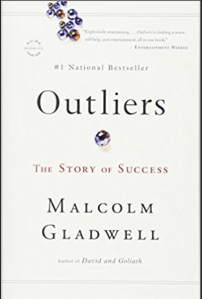
Circumstantial Evidence: a review of Malcolm Gladwell’s Outliers – The Story of Success


Malcolm Gladwell takes an engaging and colorful stab at what may be one of the biggest hoaxes of all time: the myth of the self-made success. It’s so entrenched in the popular imagination that Jeb Bush can get away with claiming to be a “self-made man.” According to Gladwell, however, it’s a person’s circumstances – and not some innate measure of his “merit” – that plays the starring role in the story of success.

Did you know that we pick athletic winners and losers by a systematic and irrational favoritism? Before you decide, Gladwell wants you to consider the following: an astounding percentage of the world’s top soccer and hockey stars were born in January.

That’s right, discrimination by birth month.

The typical cut-off date for recruiting kids for all star teams is January 1 and “age” for qualifying purposes is defined by calendar year of birth. For nine year-olds, a few months of growth advantage is huge. Kids born earlier in the year are more likely to make the cut simply because they are further along in their natural physical development, which makes them appear more “talented.” This initial competitive edge, arbitrarily rewarded, is further enhanced by superior training and exposure, thereby growing progressively larger as the myth of their greater talent continues to be reified at every subsequent stage in life. The same principle applies to other types of early advantage – nutrition, family stability, socialization (especially social training in self-confidence), travel, access to learning tools, exposure to ideas – in building the skills one needs for success.

Gladwell doesn’t claim that talent, drive, perseverance, and other personal strengths don’t figure in the equation. Rather, he argues that these qualities are not so easy to tease out from the context of opportunities. Just as being picked for the all stars early in life gives a kid the chance to actually be better at his game, things like health, nutrition, social training, and a supportive, stress-free childhood actually give people drive, perseverance, and even “talent” – which is in large measure a function of having sufficient time and opportunity to practice one’s craft, according to Gladwell (he explains that it takes ten thousand hours of practice to become a world-class expert at something, regardless of how much aptitude you may have started with). He contends that to the extent that such a thing as “innate” aptitude can be determined (IQ, for example), it forms a surprisingly small part of the story of success. One interesting 1920s study by psychologist Lewis Terman, set out to prove the opposite thesis, tracked the lives of a group of high IQ children. To Terman’s dismay, IQ had virtually no correlation with success, while social status and connections did, in a big way.

Gladwell’s side note: two children excluded from the study because their IQs were too low went on to be Nobel laureates.

The biggest overall factor in success seems to be luck. And luck means the right connections, the right socialization, the right training, and, last but not least, the right timing. (I can attest to this. I’m alive today because I was running late for work on September 11, 2001).

The idea is hardly radical. In fact, it’s borderline platitudinous. But sometimes it’s really useful to take a fresh look at an old idea. This particular old idea is one of those pieces of “conventional wisdom” that doesn’t get due consideration in our practical judgments.

It’s the sort of idea that we tend to push to the margin when assessing someone else’s character or potential, choosing to rely almost entirely on what she has accomplished without regarding the context of her life. It has implications not only for parents, teachers, employers, and grant-makers, but also for anyone despairing of life and driving himself farther into failure by doubt, self-loathing, or shame about seeking the support that could make a difference. This only exacerbates the problem. Of course, there are those who don’t consider any of this a “problem.” They would rather let the chips fall where they may, throw up their hands, and say “life’s unfair; it’s a game of luck.” Yet these are often the very same people who are most eager to promote the “by your own bootstraps” theory of success and to vilify the less fortunate as “lazy” or “irresponsible.”

Part of what makes Gladwell’s book so eminently readable is his extraordinary narrative style. He clearly delights in delving into wildly divergent and obscure stories and back-stories. It’s so delicious, you instinctively step back now and again to make sure you aren’t being seduced by a weak theory powerfully framed. And to some degree, you are.

For one, while he certainly gives you some awe-inspiring “data,” Gladwell doesn’t lay out a methodology for arriving at his characterization of them nor for drawing his conclusions from them. He reports, for instance, that 22% of the richest people of all time were born in a single year, 1835. That sounds remarkable! Except, what the hell does it mean? Being the “richest” (unlike, say, “tallest” or “heaviest”) seems to me to be very much a function of one’s era. The definition of “wealth” may vary based on – for example – how much of natural resources are (still) available, how many manufactured goods are (yet) available, and what the buying power of a unit of currency is. Having a million dollars in the height of the second industrial revolution (when people born in 1835 were in their financial prime) could make you a lot richer, by some definitions, than having that amount in any age before or since. Unless we know how the terms are being used, we can’t tell if this factoid is just tautology or if it reveals something more interesting.

Also, the bulk of the book’s persuasive power comes from anecdotes. Anecdotes are not necessarily poor in evidentiary value, but they do need to be subjected to more rigorous scrutiny than Gladwell gives them. What makes these narratives form a collective dataset rather than a series of discrete phenomena, each comprising a sample size of one? It would be helpful to know.

Still, you have to give him this much: he punches some serious holes in the “bootstrap” myth simply by exposing many, many, little-known-facts about some of the most celebrated examples of alleged bootstrapping. Ultimately, I don’t think his book needs to push a grander vision than that to be relevant, and for that reason I find its other failings to be largely forgivable.

The great thing about being sold an old and relatively modest idea by Gladwell is that he doesn’t just repeat the idea, he gives you fresh and peculiarly entertaining bits of evidence that it just might be a more compelling old idea than an alternate – and bolder, more popular, and perhaps more insidious – old idea.

He takes case after case of real-life Horatio Algers and shows that extraordinary opportunities played a much bigger role in their successes than extraordinary talents. The more spectacular the success, the more jaw-droppingly serendipitous the confluence of events that lead to it. Bill Gates had access to a computer and was allowed to program on it when he was in the eighth grade – in 1968! He was very likely the only eighth grader in the world to have had such luck. That was the first of ten astonishing – way beyond the normal distribution curve – pieces of good fortune that came his way. Bill Joy (co-founder of Sun Microsystems) had unlimited access to a computer lab in college, thanks to a bug in the time-sharing system! Each of these men, like many other “geniuses” whose careers Gladwell examines, started on his craft early enough in life to put in his 10,000 hours of practice by a relatively young age. And by the way, they all had safe, stable support systems that sustained their training routines. In other words, it may just be that a “prodigy” is groomed, not born.

Gladwell also tells two versions of his own family history. In one, they lived out the vintage American immigrant story of making it from “nothing” in a new country. But in the other version, his Jewish ancestors happened to find a niche market for a trade they already knew well (and had practiced in the old country) and his Jamaican ancestors lucked out when an influential Englishman took an interest in the island’s education system.

I really wish Gladwell would just stick to this kind of single-minded telling of these sometimes quaint and always riveting, bootstrap-bubble-bursting, tales. When he gets more ambitious, things start to fall apart. He makes broad cultural assertions that neither hold up nor illuminate his argument. For example, he gives a tortured explanation of how wet rice paddy management in ancient China led to more abstract mathematical thinking than in European societies. This is puzzling, since the historical reality does not really place China ahead of Europe in the development of mathematics.

He also makes much of something called “Power Distance Index” (PDI) – purportedly a culturally transmitted measure of how much deference a person is willing to accord to those perceived as powerful. It apparently accounts for why pilots from hierarchical societies like Korea crash more planes than those from individualistic societies like the US. It’s a tantalizingly suggestive idea.  Trouble is, PDI is inferred from the same social behavior whose effectiveness is supposed to be measured as a function of PDI. It’s just so much intellectual bootstrapping (pardon the expression) that leaves me unconvinced.

One feature of “Outliers” that moved me deeply and genuinely, is the story of Chris Langan, a man with not just an extremely high-IQ but demonstrably well-developed intellectual skills, who repeatedly tried but failed to make it in the world. He is a man who had precious little of that key ingredient of success: luck. His early life was fraught with want, neglect, violence, and uncertainty. Even when an opportunity or two came his way (as it did on occasion), he didn’t have the personal resources to take full advantage – resources like confidence and finesse, that only a stable, supportive environment during one’s formative years can engender. The irony is, a person with few material resources really needs more personal resources to survive. I think what sometimes people don’t get is how tenuous “one lucky break” is for someone who has nothing else. Maybe he doesn’t have a regular home from which to do whatever it is the break lets him do. Or the people in his life – if he has any – are either abusive and stress-creating, or are looking to him for support, rather than providing any. A guy like this is going to need superhuman amounts of self-confidence and assertiveness, just the qualities that guys like these have never had a chance to develop.

For obvious reasons, Chris Langan suffered from debilitating anxiety, self-doubt, defensiveness, social tentativeness, and extreme risk aversion, for which an extreme IQ was no match. He was easily intimidated by “authority” – including student services clerks – and unable to deal calmly and firmly with those whose decisions had enormous impact on his life. He had (and has) plenty of analytical intelligence, but he had not learned the “practical intelligence” that comes almost entirely from social instruction and a deep internal conviction, gleaned from experience, that you can usually count on things to turn out ok.

But Langan’s life kept teaching him that he could count on absolutely nothing turning out ok. “Every experience he had had outside of his own mind ended in frustration. . . . He had to make his way alone,” and, as the book’s one ultimately persuasive argument urges us to remember, “no one – not rock stars, not professional athletes, not software billionaires, not even geniuses, ever makes it alone.”

Republic Day

January 26 is “Republic Day” in India. It’s the day their constitution was ratified and it is celebrated with almost as much fanfare as the day they got their independence from Britain. People — some people — volunteer to register voters in remote villages. Kids enter essay contests. In Calcutta they have cookouts (it’s actually mild enough in January to do that!) and, of course they blast the Bollywood songs on loudspeakers.
Why don’t we do this for our constitution (Bollywood songs optional, of course)?

Come to think of it, why don’t we READ our constitution? Every middle school teacher and parent should require their kids to read it and write an essay about it.

Instead of Grand Theft Auto (or whatever the kids are playing now), why don’t we give them copies of the constitution for their 10th birthday? Am I saying that only because I am not a parent and I just don’t know what misfortune would befall me if I did that?

Maybe, but it could be, if nothing else, the perfect lesson in the idea of Sovereignty. Tell your kids that without the republican system, they would live in a world where the powers that be decided what they played, read, ate. . . .

Up With America!

It’s weird to be abroad this week. I must admit, I am missing the around the clock coverage American media must be giving to the transition in Washington. Of course, the whole world is watching – and I’m thankful for the unique perspective I’m getting (especially since I’m in a country where the Bush administration was not universally detested – more about that later). But the media here (including the regional BBC and CNN outlets) have many other priorities, naturally.

Incidentally, I am not currently able to get constant access to NPR and PBS online here as I’d planned to do when I came to India. My broadband connection has been spotty and is completely out this week. I’ve been going to an “internet café” to get online. It’s not the most convenient way to do things, but a great way to feel a part of local culture, which is a surprisingly different experience from being a part of a local family (which I am).

I met some twenty-somethings who are in a band called the “Hool” (it means something like a needle or pin prick) – they have an exciting sound too, and not free from the New-New Wave craze sweeping their generation (and making mine nostalgic).

These boys are (as creative youth everywhere tend to be) politically left leaning, but fond of America and Americans for our ideals of freedom and individual rights and respect for the rights of others – especially the equality of rights. These are the things people the world over tend naturally to ascribe to America’s essence, as strange as we ourselves may sometimes find it (either because we can’t separate it from the disapprobation we face from non-Americans when we abandon our own ideals and behave like tyrants or because we have bought into a craven view of American values as beginning and ending with the pursuit of material gain).

Members of Hool know an awful lot about American history – which impressed me. I know kids their age back home who know nothing about Indian history (or American history, for that matter). And these are ordinary middle class kids, going to public schools in what is still a relatively poor country, who don’t have internet access at home!

I could analyze the socio-political causes of this difference. I could lay out some policy direction for improving global and historical awareness among our youth. But you know what? I don’t feel like it. I just feel like savoring the feeling that there are people in the world, even among people far worse off than we are, who manage to know more than we do (if you’re comparing knowledge per unit of opportunity among similarly aged people) who nevertheless admire us. Openly admire us for all the right reasons.

A Speech For One Age

Barack Obama’s “first” inaugural address was no speech for the ages.Where was the precise distillation of some elegant truth (about the better angels of our nature or the only thing we have to fear)? Where was the stirring call to meet the great challenges of this moment in history?The call was there, of course. But it wasn’t particularly stirring. . . .

All the mundane policy references really belonged more in a state of the union speech. Worse, it sometimes sounded like a campaign speech about the “changes” that we need. As my sister said, “stop running for the office. You’re here already.” But I wonder if it isn’t ultimately a good thing that our new president sounded smart but ordinary and workhorse-like. In fact, the most “inspirational” point of the speech was not lyrical rhetoric à la “audacity of hope” but rather, “pick ourselves up, dust ourselves off, and get down to work.”

Befits the moment. No?

And thank you, thank you, THANK YOU, new guy, for promising “to be held to account and to do our business in the light of day.” This, more than any particular thing government does or does not do, preserves the integrity of popular sovereignty.

I didn’t even mind that he and the chief justice flubbed the oath. It’s in keeping with the dialed down pageantry of this inauguration day. I like this president, but I like seeing him demystified. I’ve been uneasy with the pedestal quality to the place many have bestowed on him, apparently forgetting the work he has cut out for him and the fact that he’s just a guy. A super smart guy, with great political instincts and, I believe, really good intentions. But just a guy, after all.

And by the way, if you still have any doubts about how hard this is going to be, remember that the market fell by more than 300 points, an inauguration day record.

Still, he managed to move me with his homage to our “patchwork of heritage” and his articulation of “the price and promise of citizenship” and his promise to our enemies that “we will extend our hand if you will unclench your fist.” Best of all, he quoted Thomas Paine, my favorite Founding Father.

So, maybe he is striking the right balance (deliberately or inadvertently) between getting us charged up and keeping it real. And while it was no speech for the ages, perhaps it was one for this age.

Checking In

Sorry to be MIA, I am out of the country.

I am spending a few weeks in India, where, although it’s a democracy (and not one of those sham ones with just one party), there’s actually a province where the communist party has held power for three decades (they’ve been elected)! Interestingly, these “communists” don’t seem to mind privatization (“liberalization” as they call it here) of any industries. At least from what I can tell (I don’t claim to be an expert).

But there are plenty of Indian communists who do seem to have traditional communist preferences (they tend to be from regions where communists are out of power). I heard one of them say that the current global economic crisis “proves everything we’ve been saying for years.”

Wow. It’s hard to believe otherwise intelligent people really think the failures of capitalism is an argument for communism. That’s like saying because beans give you gas, you should be eating poop instead.

On that classy note, I’m going to rush away. I will check back soon. I hope you do too.

Koli Mitra